
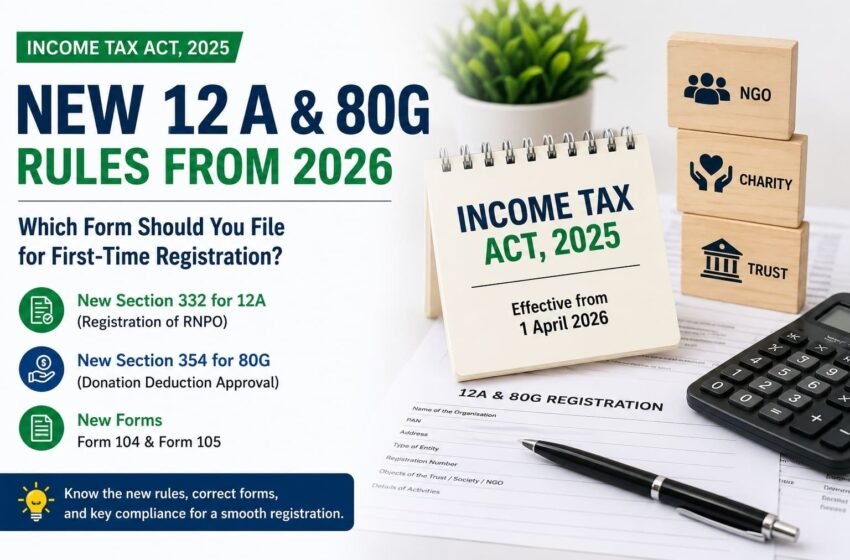
India’s charitable and non-profit sector is moving into a new compliance structure from April 2026. The updated Income-tax framework has changed the numbering of important sections related to NGOs, trusts, societies, and Section 8 companies.
Because of these changes, many organisations are now confused about one important question:
If an NGO is applying for 12A registration for the first time, which form should be filed under the new rules?
This article explains the answer in simple language without complicated legal wording.
Why 12A Registration Matters for NGOs
12A registration is the basic tax exemption registration for charitable organisations in India. Without it, the income earned by a trust or NGO may become taxable.
Once approved, the organisation can claim exemption on eligible income used for charitable purposes.
For many NGOs, this registration also improves:
- donor trust,
- legal credibility,
- funding opportunities,
- CSR eligibility,
- and long-term operational stability.
What Changed in 2026?
The Income-tax Act has reorganized many provisions related to charitable institutions.
Earlier, NGOs mainly dealt with:
- Section 12A
- Section 12AB
- Section 80G
- Form 10A
- Form 10AB
From April 2026 onward, these provisions are shifted into a newly structured framework.
New Section Numbers for NGOs and Charitable Trusts
The updated structure now works like this:
| Old Provision | New Provision |
|---|---|
| Section 12A / 12AB | Section 332 |
| Section 80G | Section 354 |
| Form 10A | Form 104 |
| Form 10AB | Form 105 |
The government has also started using a broader classification for charitable entities under a Registered Non-Profit Organisation framework.
Which Form Should Be Filed for First-Time 12A Registration?
For most organisations applying for registration for the first time, the applicable form under the new system is:
Form 104
Form 104 is expected to become the primary application form for fresh charitable registration.
This generally applies when:
- the organisation never obtained 12A approval earlier,
- there is no existing exemption registration,
- or the NGO is entering the exemption framework for the first time.
What If the NGO Already Filed Income Tax Returns Earlier?
This is where many applicants become confused.
A trust or society may already exist for several years before applying for registration. During those years, the organisation might have filed:
- ITR-7,
- NIL returns,
- or other income tax returns.
However, previous return filing alone usually does not change the application into a renewal case.
If no earlier 12A or 12AB approval exists, the registration is still generally treated as a first-time application.
In such situations, Form 104 is normally the relevant filing form.
When Is Form 105 Used?
Form 105 is mainly intended for organisations already connected with the exemption system.
This form may apply in situations like:
- renewal of existing approval,
- converting provisional registration into regular registration,
- modification in trust objects,
- revalidation requirements,
- or continuation-related compliance.
In simple terms:
- Fresh applicant → Form 104
- Existing registered applicant → Form 105
New Rules for 80G Registration
The donor deduction system also continues under the new law.
The earlier Section 80G structure is now reorganized under Section 354.
This approval allows donors to claim deduction on eligible donations made to approved organisations.
For NGOs, obtaining this approval can help increase donation confidence because many contributors prefer donating only to tax-approved institutions.
Compliance Is Becoming More Strict
One major change expected under the new system is stronger digital verification.
Authorities are likely to focus more on:
- donor record matching,
- PAN verification,
- financial transparency,
- activity proof,
- and proper accounting documentation.
Organisations with weak documentation may face delays, notices, or additional scrutiny.
Documents Usually Required for Form 104
Before applying, NGOs should organize their records properly.
Basic Documents
- PAN card of organisation
- Trust deed or MOA
- Registration certificate
- Address proof
- Trustee or director details
- Aadhaar and PAN of office bearers
- Bank account information
Financial Documents
- Previous Income Tax Returns
- Balance sheet
- Income and expenditure account
- Donation records
- Activity reports
- Supporting proof of charitable work
If the organisation existed for previous years, historical records may also be reviewed by the department.
Common Mistakes Made by NGOs During Registration
Many first-time applicants rush the filing process and later receive notices.
Some common problems include:
- incomplete trust deed,
- incorrect charitable objects,
- mismatch in PAN details,
- inactive bank accounts,
- missing financial statements,
- lack of activity proof,
- or wrong form selection.
Proper preparation before submission can reduce the risk of rejection.
Should NGOs Apply for 12A and 80G Together?
In many cases, organisations prefer applying for both registrations together.
This approach can help because:
- the NGO receives exemption benefits,
- donors can claim deduction,
- fundraising becomes easier,
- and overall compliance structure becomes stronger.
However, approval depends on proper documentation and genuine charitable activity.
Key Takeaway
The new Income-tax framework from April 2026 has changed both section numbers and form numbers for charitable organisations.
For most NGOs applying for tax exemption registration for the very first time, Form 104 is expected to be the primary filing form under the new rules.
Form 105 is generally intended for renewal, conversion, modification, or continuation cases.
As compliance scrutiny increases, NGOs should focus on maintaining transparent financial records, proper documentation, and genuine charitable activities before filing their application.
For official updates, filing utilities, and notifications, organisations should regularly visit the official Income Tax portal.
urlIncome Tax Department Official Portalhttps://www.incometax.gov.in